Fire Emblem: Thracia 776 is a Japanese tactical role-playing game developed by Intelligent Systems and published by Nintendo, and the fifth installment in the Fire Emblem series. It is also the third and final Fire Emblem title to be released on the Super Famicom, as well as the final Fire Emblem designed by series creator Shouzou Kaga.
Thracia 776 was originally released on September 1, 1999 through the Nintendo Power service. This Japan-exclusive service allowed people to use writable game cartridges to purchase and download game ROMs from kiosks in select retail locations. The game was subsequently given a proper boxed retail release on January 21, 2000, during the last days of the Super Famicom. Later, the game was released on the Wii and Wii U in Japan as a Virtual Console title in 2008 and 2013 respectively.
Development
According to developer Shouzou Kaga, Thracia 776 was created to satisfy the demands of older Fire Emblem fans who had issues with the gameplay in Genealogy of the Holy War.[1] To that end, the game returns to a more traditional chapter and map structure compared to Genealogy, which featured far larger maps and fewer distinct chapters.
Mayumi Hirota was first brought to the Fire Emblem series to work on the Fire Emblem Treasure artbook for Genealogy, and she was made the illustrator for Thracia 776.
In mid-1999, prior to the release of Thracia 776, Kaga left Intelligent Systems under acrimonious circumstances to found his own company, Tirnanog, where he began work on TearRing Saga: Utna Heroes Saga. Hirota followed Kaga and worked as character designer on Utna Heroes Saga. Her character designs were later used in Kaga's Vestaria Saga I.
Setting
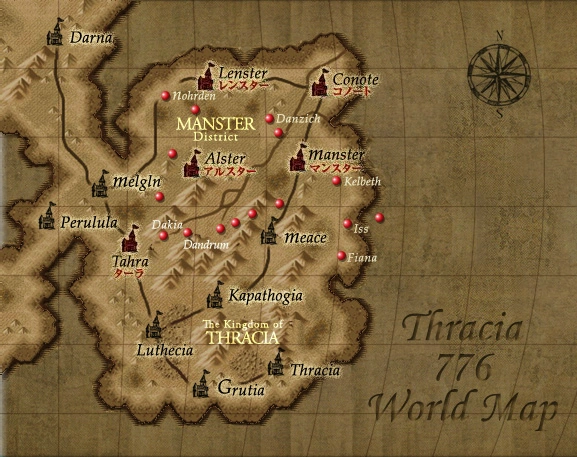

The world map of Thracia 776 featuring the southeast portion of the continent.
- See also: Jugdral Series
Thracia 776 takes place during the events of Fire Emblem: Genealogy of the Holy War. During Genealogy of the Holy War, in the year Gran 761, the ruler of Grannvale, Arvis has expanded his country's rule across the whole of Jugdral. Thracia 776 is set between Chapter 5 to Chapter 8 of the second generation storyline, while the exiled prince Seliph is still in hiding and preparing to battle Arvis's hold on the continent.
In the Thracian peninsula in southeastern Jugdral, the Munster District was subjugated following the deaths of Prince Quan of Leonster and his wife Ethlyn in the Aed Massacre. However, shortly after capturing it, Thracia was defeated by Grannvale and forced to cede control to Friege, becoming a servant state to the empire. Leif, the deposed heir to the Republic of Munster, who was rescued from an attack by the forces of Thracia by Finn, a friend of Seliph's father Sigurd, starts a revolution against the Empire's occupation of the Munster District.
Several characters from Genealogy of the Holy War return, such as Finn, Diarmuid, Ced, and Nanna, while others appear as cameos, such as Seliph (the main protagonist in part 2 in Genealogy of the Holy War), Julius, Julia, Altena, Coirpre, and Hannibal. Some original characters are also introduced, such as Halvan, Orsin, Lifis, Shiva, Dagdar, Machyua, and Mareeta.
Story
Spending most of his life on the run, Leif eventually finds shelter in the village of Fiana. One day, the villager's protectors are routing bandits when Raydrik, the new Duke of Munster, attacks the village in search of Leif, kidnapping Leif's friends Nanna and Mareeta. Devastated by the town's destruction and his friends' abductions, Leif decides to face the forces of Thracia and retake Munster. Aided by Finn and a growing band of rebels, he rescues both Nanna and the enemy-controlled Mareeta, and defeating the forces of both Raydrik and Veld, a high-ranking priest of the Loptr Church, as they retake Munster and liberate northern Thracia. Leif's forces finally face Raydrik in battle, but upon his defeat Veld transforms him into an undead monster called Deadlord Mus. Leif destroys Mus, kills Veld, and cements his forces defending Munster and northern Thracia from the Grannvale army.
Gameplay
Fire Emblem: Thracia 776 uses the same skill system that was introduced in Genealogy of the Holy War. It also introduced several gameplay features that have since become staple mechanics of Fire Emblem combat.
Fog of War combat, also known as night combat, is a new element present in certain chapters. In Fog of War chapters, the map is completely obscured by darkness, causing characters to see only a few tiles around them. Torches and Torch Staves can be used to increase the vision radius, but lose one square radius of effectiveness every turn.
Capturing is a new command available to both the player and enemy units. When attempting to capture an enemy, the unit making the attempt has their stats halved. HP must be reduced to 0 to successfully capture. When captured, enemies can be looted of any equipment and items they had on their person. Bosses, including the final boss, can also be defeated through capture, and will respond with a different death quote. Units without weapons equipped, such as priests, are instantly captured with no combat taking place. If one of the player's units is captured, the enemy will take all of their items. To free a captured unit, the player must kill the unit that captured them.
Fatigue is a new system unique to Thracia 776. When a character performs an action, they gain various points of fatigue. When a unit's fatigue exceeds their maximum HP, they cannot participate in the next chapter. This mechanic is meant to encourage the player to avoid relying on a select few units and to switch out units from chapter to chapter. Fatigue values for a character are reset when they are kept out of battle for a chapter regardless of whether they had exceeded their allowed maximum fatigue. Fatigue can also be cured with Stamina Drinks. Leif, the game's lead character, is the only playable unit immune to the effects of fatigue.
Gaiden Chapters were also introduced in Thracia 776. If the player completes specific conditions in certain chapters, the story will proceed to a bonus chapter, where the player may acquire a valuable item or a new character.
Escape chapters were also introduced in Thracia 776 and actually make up a bulk of the first half of the game due to the relatively small army Leif commands at that point. In some cases, a unit captured during an Escape chapter can later be rescued in a Gaiden chapter. In order to evacuate everyone safely, the player must often have Leif linger, leaving him exposed to danger. Escape chapters in Thracia 776 give the enemy unlimited reinforcements.
Like Fire Emblem: Mystery of the Emblem, Thracia 776 also has the Dismount feature. Lance Knights and Axe Knights are forced to use swords when on foot. Cavalry and aerial units are forced to fight dismounted during chapters set indoors.
Thracia 776 also introduced the Rescue command, allowing one character to pick up and carry another, provided the character intended for rescue is light enough for the rescuing unit to carry. While carrying a rescued unit, the rescuer takes a temporary penalty to their speed and skill. While being carried, rescued units are completely safe and will not enter combat, though if their rescuing unit is defeated, they will become exposed to battle once again. Mounted characters can not be rescued, but they can rescue those heavier than them. Units with maximum Build can not be rescued.
Characters
- See main article: List of characters in Fire Emblem: Thracia 776.
Chapters
- See main article: Chapters (Fire Emblem: Thracia 776).
Classes
- See main article: List of Classes in Fire Emblem: Thracia 776.
Legacy
Fire Emblem: Thracia 776 is the final title developed by the creator of the Fire Emblem series, Shouzou Kaga, before his departure from Intelligent Systems. It is widely considered one of the forgotten titles of the franchise as it is one of the lowest-selling titles in the entire franchise. Some have attributed to its unusual release, first on the Nintendo Power service in 1999 and as a boxed retail product in 2000, as well as its status as a new Super Famicom title released well into the lifespan of the Nintendo 64 and competing consoles of the era.
Unlike its immediate predecessor and immediate successor titles, Thracia 776 has suffered from a significantly lower interest in the west. This has translated into the overall popularity of the game and its characcters, which most failing to place in a prominent rank during the Fire Emblem Heroes annual Choose Your Legends event with its main protagonist Leif being one of the few characters to consistently rank high as a Lord, yet as of 2026, in its tenth round, Leif is one of four Lord equivalent characters to fail to win any Choose Your Legends event and is currently the only Lord from a game released prior to Heroes to have yet to place. His best showings have kept him in the overall Top Twenty in several events, though none have placed him in the top 10. The only other character to consistently rank in the top 100 and the highest ranking Thracia 776 exclusive character is Reinhardt, who has seen as high as 11th overall, though his popularity is more attributed to his notoriety in Heroes, rather than his legacy from Thracia 776 as the inaugral event had him at a measly 584 out of a total 791 eligible Heroes.
Trivia
- Fire Emblem: Thracia 776 was the last game in the series to be released in the 20th Century, and the first to be released in the 2000's.
- Fire Emblem: Thracia 776 is the first game in the series that never affords the player an opportunity to resurrect a dead unit.
Gallery


.png "Fire Sword Effect (FE5).png (14 KB)")
External links
- Official site of Fire Emblem: Thracia 776 - In Japanese
References
- ↑ Interview with Shouzou Kaga, Famitsu June 4, 1999