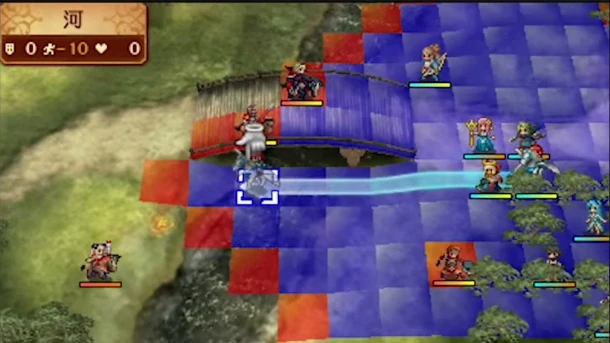
The movement system as present in Fire Emblem Fates.
Movement is a statistic present in all Fire Emblem games. It determines the range, or the number of adjacent tiles, a unit can move in one turn.
Overview
Movement is the stat that determines how far a character can move on a map during their turn. While not a command with a menu prompt, after selecting an active playable character, the player may freely Move their character within their character's movement range. The Movement Range battlefield UI has several color distinctions with blue filters over tiles denoting all valid tiles a character may move onto, red filters denoting their maximum attack range from the edge of their movement range based on their current Inventory, and green filters denoting maximum effect range for Staves after movement. Once the player has completed an action during a turn that puts a character in a Wait state, a character can no longer Move for the remainder of the Player Phase. Any Movement not used during a turn is not stockpiled for most situations and character can only regain their ability through a refresh via Dancing or once the player goes through an entire Enemy Phase before returning to the Player Phase once more.
Games automatically map out how the character moves in that range, generally mapping out the most efficient path possible, though players can manipulate this movement to address certain obstructions, terrain, and enemy positions on the path so long as it remains within that movement range and does not exceed the maximum allowed moved spaces. Movement can be affected by certain conditions like Rescue, Fatigue, and Petrification. The biggest general changer to movement are a map's terrain. The most basic Plains and Floors having no affect on any Unit Type. Certain terrain hampers movement for certain Unit Types like Forests and Desert/Sand. Some outright obstruct movement like walls and every map has a limited area that the player plays within, preventing movement outside of this boundary. Some terrain hazards, traps, and stumbling on an enemy in Fog of War may also abruptly end movement.
Unlike other base stats, Movement is primarily determined by a character's Class. For example, Armored Units such as Knights are noted for their extremely low movement due to their heavy armor while Horseback Units have higher movement due to the superior mobility of their Horse mount. While it is a visible stat on a character's stat profile, most games do not feature a Growth Rate for Movement except in Fire Emblem: Thracia 776, albeit it has an extremely low growth. The primary means of changing Movement are Class Changes, with Promotions generally granting a space or two of extra movement. Movement does have a dedicated consumable item that grants a permanent increase to a character's movement with the Boots item. However, this item is among the lowest available in each game with generally only one or at most two Boots in the entire game. Some Skills may also grant movement such as Rally Movement and Movement +1. Notably the Canto skill grants additional movement or access to excess movement after performing certain actions.
Elements
Movement cost
- See also: Terrain
Each type of terrain has a movement cost associated with it, which determines a unit's movement across that terrain. For example, forest typically costs 1 move to cross, therefore, units with 5 moves will have only 4 moves left crossing it. Different classes or different unit types also play a vital role in determining the movement cost for each terrain. For example, horse-mounted units such as Cavaliers or Troubadours tend to have higher movement cost to cross forest than infantry and flying units, or units such as Brigands and Berserkers are able to cross mountain and sea while other infantry units cannot.
Items
- See also: Boots
Different games of the Fire Emblem series and the related title, TearRing Saga: Utna Heroes Saga, introduced various forms of the movement improving item which share the same effect, to increase a unit's movement by an amount, either by equipping (in Fire Emblem: Genealogy of the Holy War) or consuming:
- Leg Ring - Genealogy of the Holy War and Thracia 776.
- Movement Plus (potion) - TearRing Saga: Utna Heroes Saga.
- Swiftsole - Fire Emblem: The Sacred Stones.
- Boots - all other games.
In Thracia 776, where movement has a growth rate, there is the Dain Scroll which is capable of manipulating the growth rate by placing it in a unit's inventory.
Skills
The following is a list of skills that affect a unit's movement:
- Canto - allows the user to use up leftover movement after completing an action.
- Celerity - increases movement by 2.
- Movement +1 - increases movement by 1.
- Acrobat - allows the user to cross any traversible terrain for a movement cost of 1.
- Rally Movement - upon use of the Rally command, increases movement of all allied units by 1 in a 3-tile radius of the user for one turn.
- Galeforce - allows the user another full action after they defeat an enemy during the user's Turn (only once per Turn)
- Deliverer - increases movement by 2 when Pair Up is used.
- Rally Heart - upon use of the Rally command, increases stats and movement of all allied units by 2 and 1, respectively in a 3-tile radius of the user for one turn.
- Surefooted - increases movement by 1 and allows the user to cross any traversible terrain for a movement cost of 1. Ballistician only.
Fire Emblem Heroes
Fire Emblem Heroes has a unique movement system to fit the mobile platform. In this game, a unit's movement is determined by the group they belong to.
 Infantry: can move two spaces, slowed by forests.
 Cavalry: can move three spaces, cannot move through forests.
 Flying: can move two spaces, ignores all terrains.
 Armored: can move one space.


