
Wolt performing a critical hit on an enemy bandit in battle in Fire Emblem: The Binding Blade.
A Critical Hit (必殺 Hissatsu lit. Certain Kill) occurs when a unit performs a stronger-than-average attack that deals triple damage to their target.
Overview
A critical hit is a chance-based, stronger-than average attack. A critical hit in most cases deals three times the damage of a normal attack. There are also exceptions to this norm. Fire Emblem: Genealogy of the Holy War and Fire Emblem: Thracia 776 double the user's attacking stat rather than the flat damage.
Critical hits are usually cued by special, more dynamic attack animations and unique sound effects. Several games include a character portrait cut-in when unleashing a critical hit. Starting from Fire Emblem Awakening onward, characters may have unique voice lines when unleashing a critical hit.
Any character of a combat-capable class has the potential ability to perform a critical hit. Enemy Units, including some bosses, are also capable of performing such attacks. Stat-wise, these are often associated with Dexterity/Skill as well as the Luck stat in some games. The largest variable in critical activation chance is is a character's equipped weapon, as some, such as the Killer weapons, provide an innately higher boost to a character's chance to perform a critical attack. Other modifiers include certain skills like Wrath and Gamble. Some classes such as the Berserker or Swordmaster also provide a passive increase to the unit's critical attack chance.
In games with a weapon forging mechanic, it is possible for the player to create weapons with high critical attack chance. Fire Emblem Engage introduces Engraving weapons, which can also increase critical hit rates.
Regarding combat skill activations, the critical multiplier is applied after the base damage is calculated with the involved skill. For example, with an offensive skill like Sol, the critical hit would triple the damage and heal the user based on the damage from the critical hit. For Luna, it applies the Defense reduction on the enemy before applying the critical hit multiplier.
Certain weapons have unique traits or interactions regarding critical hits. In Fire Emblem Fates, Bronze Weapons are completely incapable of critical hits, and both the Killer line of weapons and Mjölnir deal a critical damage multiplier of four times the base damage instead of three. Also, Devil weapons, which have an innate chance to deal backfire damage against the wielder, can inflict critical damage on the wielder as well, if they are especially unlucky.
Calculations
A Swordmaster performs a critical hit.
Factors
- Class Critical Bonus: Some promoted classes, notably the Swordmaster and Berserker, have a "class critical bonus", which represents a base critical hit rate a member of the class will almost always have in battle. In Fire Emblem: Radiant Dawn, there were five levels of Class Critical Bonuses (Critical +5, Critical +10, Critical +15, Critical +20, Critical +25), represented as skills permanently attached to the Sniper, Marksman, Reaver, Halberdier, Sentinel, Assassin, Myrmidon, Swordmaster and Trueblade classes.
- Skills: Some skills increase critical hit rate under certain circumstances. For example, the Wrath skill boosts the critical hit rate when the user's HP is at 1/3 or less while Death Blow increases critical hit rate when the user initiates a battle.
- Follow-up Critical Multiplier: In Fire Emblem: Thracia 776, there exists a hidden stat that multiplies a unit's critical rate when they perform a Follow-Up Attack. The value of the FCM is unit-specific.
- Dual Support in Fire Emblem Awakening and Fire Emblem Fates boosts the critical activation rate depending on the support rank level that the attacking unit has with their Pair Up partner and any adjacent allies. Critical activation is boosted by 10 at level 4, 15 at level 8, and 20 at level 12.
Critical hit rate calculation
See page on Critical rate.
Representation in Non-Fire Emblem Games
Super Smash Bros.
Final Smashes
In the Super Smash Bros. series, Marth, Roy, and Lucina share a Final Smash called "Critical Hit" that is framed as the character performing a critical attack on their target. The Final Smash mechanic was first introduced in Super Smash Bros. Brawl, and these characters have shared the Final Smash through all entries in which they appear through Super Smash Bros. Ultimate.
Lucina, introduced in Super Smash Bros. for Nintendo 3DS and Wii U, shares the same critical attack animation as Marth, while Roy's version is based on the critical attack animation when he uses the the Binding Blade in the game of the same name.
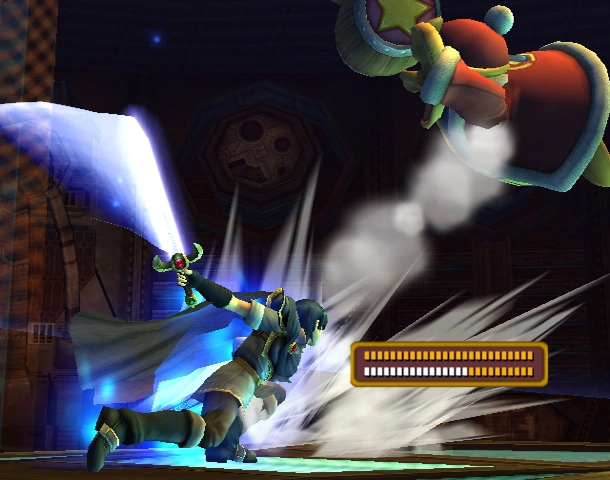
Marth using Critical Hit on King Dedede in Super Smash Bros. Brawl
In Marth's version of the attack, he raises his sword, and then rushes forward to the end of the platform he is on, striking the first enemy that he runs into. He can knockout multiple enemies if they are in close proximity with the first enemy. A health meter that resembles the one in Shadow Dragon and the Blade of Light appears over the head of each opponent hit by the attack and depletes to zero as a flourish. The Final Smash is also usable in the air, in which case Marth with air-dash.
In Brawl, Marth does not stop charging unless he hits an opponent, meaning that if his Final Smash does not strike an opponent, there is a possibility he could fly off the stage. In later games, this was adjusted so that he only charges forward a maximum set length. Lucina's Critical Hit attack is functionally identical to Marth's, with the only difference being that the health meter displayed over her opponents visually resembles the one in Fire Emblem Awakening.
Roy has a unique Critical Hit animation compared to Marth and Lucina as his is stationary. Roy recreates his critical hit animation from The Binding Blade by winding his blade backward in a wide circle, dragging any character within one character length in front of him into a locked state. Enemies directly positioned behind him when his blade arcs behind him are flung directly in front of him. Roy then slams his blade onto the enemies in front, generating a large explosion that knocks back foes both stunned during the move and any enemy within range of the explosion. Roy ends his move by sheathing his sword, though draws it immediately and goes back into his idle stance.
Killing Edge
Ultimate also introduced the Killing Edge as one of the various weapons and items that has a random chance of spawning from item containers. If the sword's blade glows red, the next attack performed with the Killing Edge deals three times the damage it would normally do, similar to critical hits in Fire Emblem.
Trivia
- In Engage, the Emblems that provide the highest bonus to critical rate when engraved on weapons both coincidentally originate from Fire Emblem Fates. Both Corrin and Camilla's Emblems add +30 to critical chance.
- Veronica's Emblem, by contrast, reduces a weapon's critical chance by -20. Hers is the only Emblem to inflict a penalty on critical chance. Further, her home game, Fire Emblem Heroes, does not feature critical hits.
Gallery
Fire Emblem: Mystery of the Emblem

Fire Emblem: Thracia 776


TearRing Saga: Utna Heroes Saga


Game Boy Advance games


Fire Emblem: Radiant Dawn
Super Smash Bros. for Nintendo 3DS and Wii U


